Skip to textbook content
Doctor’s PassportTextbook
QuestionsFlashcardsBriefsDashboardAccount
TopicsAll topics

Loading topic navigation…

Textbook navigation
TopicsAll topics

Loading topic navigation…

← Ear, nose and throat indexChapter sections
Principles and purposeSituations and prioritiesAssessment and interpretationWorked approachesFeedback, follow-up and evidenceSpecial situationsCommon pitfallsQuestionsSources
Full textbook9 sectionsOpen only what you need
Educational draft · awaiting clinical reviewThe full textbook explains uncertainty but does not replace live national or local guidance, specialist advice, or current prescribing information.

Emergency front-of-neck airway principles

Ear, nose and throat · UK scope · Sources checked 8 Sept 2026 · Clinical review pending

RapidFull
!
Declare failure to oxygenate and progress to rescue

When tracheal intubation, supraglottic rescue and the final optimised face-mask attempt have failed, continued ineffective attempts can consume the remaining time before hypoxic injury.

Action: Declare cannot intubate, cannot oxygenate, call for help and proceed immediately to the adult emergency front-of-neck airway plan. Maintain oxygen delivery attempts, ensure full neuromuscular blockade and deploy the prepared operator, assistant and equipment; do not await cardiac arrest or another routine intubation attempt.

Principles and purpose

Recognise failure to oxygenate during adult airway management, understand the transition to emergency front-of-neck access and support a coordinated rescue with verified ventilation.

A front-of-neck airway creates a route below an upper-airway problem when conventional approaches cannot provide oxygenation. It is a rescue capability requiring practical training, anatomical familiarity and preparation. The decision to perform it should be driven by the failure of oxygenation and the completed rescue sequence, rather than by waiting for a particular saturation value or a cardiac arrest. The adult framework does not automatically transfer to a small child's different airway anatomy.

DAS 2025 retains a progression from tracheal intubation to supraglottic rescue, a final optimised face-mask attempt and emergency front-of-neck access. It also emphasises work done before the crisis: anticipating difficulty across every route, discussing the strategy and making equipment immediately available. A rescue team needs a shared account of which attempts have failed and what is happening next. A technically skilled operator still depends on effective assistance, monitoring and timely recognition.
Key points

Practice

Two practice questions

Your practice draft is saved in this browser.

Question 1 of 2
0 correct
Ear, nose and throatOriginal SBA

The trigger for adult Plan D

In an anaesthetised adult, tracheal intubation and supraglottic rescue have failed. A final optimised two-person face-mask attempt also fails to oxygenate. Which action follows the DAS adult rescue framework?

Choose one answer, then submit
← Rapid synopsisBack to overviewAll Ear, nose and throat topics →
Sources and review status6 sources · checked 8 Sept 2026 · clinical review pending+
Sources

Sources and review status

National guidance is shown before implementation-dependent detail. Apply principles in context and verify current guidance when a decision affects care. Source check completed 8 Sept 2026; clinical approval remains outstanding.

  • DAS 2025 unanticipated difficult intubation: current adult algorithms
  • DAS 2025 official overview slides: rescue, monitoring and aftercare
  • DAS official change summary: default longitudinal approach and early preparation
  • DAS adult difficult-airway trolley: Plan D equipment
  • DAS April 2026 AirDrills facilitator guide: team transitions and debriefing
  • DAS 2025: official adult Plan D scalpel–bougie–tube figure

Editorial contact: Doctor’s Passport editorial team. Source-check date is separate from clinical approval. Report a content problem · Content changes

Authoring stateComplete draftClinical stateAwaiting reviewJurisdictionUnited Kingdom
  • Emergency front-of-neck access is the adult Plan D response to cannot intubate, cannot oxygenate after Plans A–C fail.
  • Failed intubation alone is different: successful supraglottic or mask ventilation allows the team to pause, communicate and select a safer next strategy.
  • Prepare the neck rescue plan and equipment before a crisis; prime for it as earlier airway rescue becomes difficult.
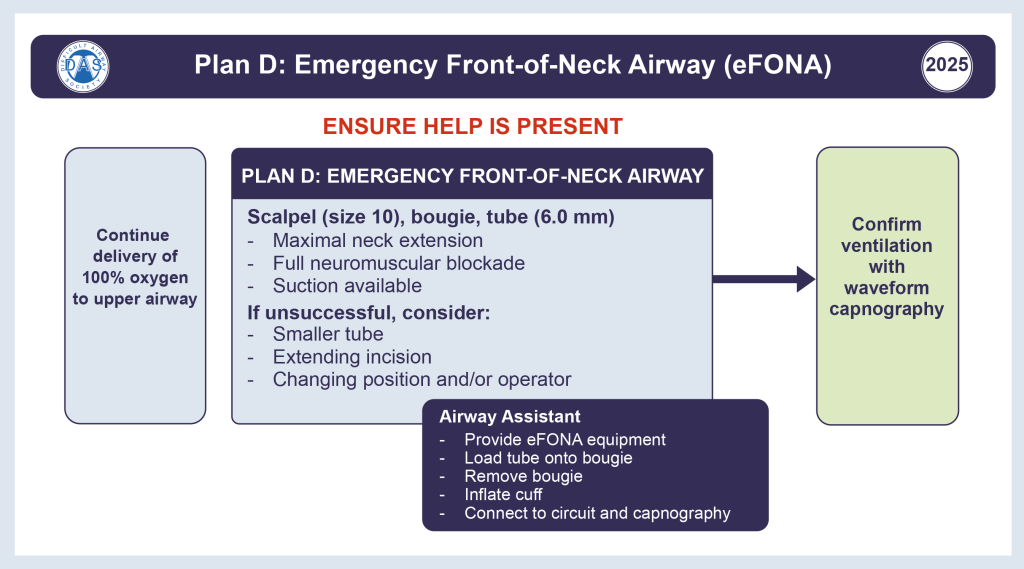
  • DAS 2025 uses a default vertical skin incision and a scalpel–bougie–tube approach, with a trained technique selected and communicated in advance.
  • Maintain oxygen delivery, ensure a full neuromuscular block and extend the neck maximally where feasible while the trained operator performs rescue.
  • Verify ventilation with sustained exhaled carbon dioxide, clinical response and continuous monitoring; secure the airway and arrange specialist aftercare.
  • Situations and priorities

    Identify the physiological failure

    Ask whether ventilation and oxygenation are effective through the current device. A tube entering the mouth or a supraglottic device sitting in position is not evidence that the lungs are receiving gas.

    Distinguish difficulty from failed rescue

    A difficult laryngoscopic view with reliable face-mask ventilation is not yet the same situation as failure of all noninvasive oxygenation routes. Make the distinction explicit so that each decision reflects the patient's actual state.

    Track progress through the plans

    Record the attempted technique, operator and response. When a supraglottic device does not ventilate and the final optimised mask attempt also fails, verbalise the cannot-intubate, cannot-oxygenate state rather than describing the airway as merely difficult.

    Recognise cognitive delay

    Repeatedly changing blades without changing an ineffective strategy, failing to call for help or waiting for another senior arrival can delay rescue. Any team member should be able to state the loss of oxygenation and ask which plan is active.

    Red flags requiring action

    • No effective ventilation through the attempted routes, deteriorating oxygenation or an unreliable capnography trace demands explicit reassessment and progression through the rescue plan.
    • Continued fixation on laryngoscopy despite failure of oxygenation is a team emergency; state the problem clearly and direct attention to the agreed rescue route.

    Assessment and interpretation

    1. 01
      Continuous waveform capnography
      Why
      Assess ventilation throughout airway management and after rescue.
      Interpretation and limitations
      Check the monitor before induction and maintain its use through rescue. After a tube is placed, sustained exhaled carbon dioxide supports effective ventilation; absent or disappearing output requires immediate evaluation of patient, airway and equipment.
    2. 02
      Clinical ventilation and oxygenation assessment
      Why
      Interpret the monitor alongside the patient's physiological response.
      Interpretation and limitations
      Observe chest movement, delivered ventilation, saturation trend and circulation. A single monitor value cannot replace the assessment of whether the current route is working, and waiting for profound desaturation can delay necessary action.
    3. 03
      Pre-induction neck assessment
      Why
      Anticipate the feasibility of emergency access before it is needed.
      Interpretation and limitations
      Identify the cricothyroid membrane between the thyroid cartilage above and cricoid cartilage below. Assess body habitus, previous surgery and distortion before induction. This supports preparation; new imaging during established failure to oxygenate must not delay rescue.
    4. 04
      Post-rescue specialist airway assessment
      Why
      Confirm a secure ongoing airway and identify associated injury.
      Interpretation and limitations
      The surgical and anaesthetic teams review the procedure, tube position, bleeding and subsequent airway plan. Reassess unexpected ventilation difficulty immediately; a successful initial rescue does not remove the need for monitored aftercare.

    Worked approaches

    01Worked caseProgress when every noninvasive route failsDuring adult anaesthesia, intubation has failed and the prepared second-generation supraglottic device does not provide effective ventilation.+
    1. 1The team makes the final face-mask attempt with two-person technique, appropriate adjuncts, optimised positioning and adequate anaesthesia and neuromuscular block. No effective chest movement or sustained capnography appears and oxygen saturation continues to fall.
    2. 2The airway lead declares cannot intubate, cannot oxygenate. The assistant opens the already located neck-access kit, a colleague continues oxygen delivery attempts and the trained operator proceeds to the agreed Plan D technique.
    3. 3The trained operator uses longitudinal skin access and blunt exposure to identify the cricothyroid membrane, opens the membrane and passes the cuffed tube over the bougie. After bougie removal and cuff inflation, ventilation produces repeated capnography waveforms and visible chest expansion; oxygen saturation then rises.

    Feedback, follow-up and evidence

    • Continue uninterrupted capnography, oxygen saturation and haemodynamic monitoring through the rescue and subsequent transfer; reassess unexpected changes promptly.
    • Check tube fixation, ventilation effectiveness and the neck for progressive bleeding or swelling while awaiting the definitive surgical plan.
    • Record the patient's neurological and physiological recovery after the hypoxic episode with critical-care input where required, avoiding premature conclusions from a single early observation.
    • Confirm that the event, future airway implications and follow-up responsibility reach the patient and the receiving clinical team, rather than remaining only in an informal debrief.

    Special situations

    Priming begins before Plan D

    Opening the kit and naming the potential operator before complete failure reduces the number of tasks that must begin simultaneously at the crisis point. Preparation is compatible with continued attempts to restore oxygenation through the earlier plan.

    A default technique needs rehearsal

    The 2025 default longitudinal skin approach simplifies the shared plan, but familiarity with words is insufficient. Clinicians need regular practical training with their available equipment and an understanding of the anatomy and troubleshooting.

    A declaration changes team priorities

    Saying that oxygenation has failed provides a common trigger for action. It helps the assistant stop preparing another ordinary intubation attempt and begin the equipment, positioning and support required for rescue.

    Team drills test transitions

    A short locally facilitated drill can reveal uncertainty about who calls for help, where the kit is kept or how failure is verbalised. Repeating the transition after feedback tests whether the team has corrected that specific weakness.

    Common pitfalls

    1. 01

      Equating failed intubation with immediate failure of oxygenation can bypass a functioning rescue route; conversely, assuming a device works without confirming ventilation can delay Plan D.

    2. 02

      Waiting for cardiac arrest before declaring cannot intubate, cannot oxygenate treats a late consequence as a necessary diagnostic criterion.

    3. 03

      Searching for equipment only after all routes have failed wastes the preparation opportunity built into the adult airway strategy.

    4. 04

      Treating neck tube placement as the endpoint without confirming sustained ventilation can miss an unsuccessful rescue or subsequent displacement.

    4
    The team secures the tube, continues monitoring and arranges surgical and critical-care assessment. The record includes the failed routes, timing, successful technique and observed response, making the outcome and future airway warning explicit.
    02Prepared adult rescueCoordinate operator, equipment and verificationEarlier rescue is becoming difficult and the team may need emergency front-of-neck access.+
    1. 1Communicate who will perform the procedure and who will assist, obtain further help and monitor physiology. Bring the actual kit into useable reach, with the current algorithm visible.
    2. 2The DAS adult trolley includes a size 10 scalpel, bougie, size 6.0 tracheal tube and cuff syringe for Plan D. Check that the team can locate and connect the equipment it is trained to use.
    3. 3Once Plans A–C cannot provide oxygenation, proceed to adult Plan D without another routine intubation cycle. Maintain upper-airway oxygen delivery, ensure full neuromuscular block and extend the neck maximally where feasible.
    4. 4The trained operator follows the current DAS sequence: longitudinal midline skin access with blunt exposure, identification and controlled opening of the cricothyroid membrane, then bougie placement into the trachea and advancement of a cuffed size 6.0 tube over it. Remove the bougie, inflate the cuff and connect the breathing system. These principles require hands-on procedural training and the current detailed algorithm.
    03After oxygenation is restoredSecure recovery and learn from the eventEmergency access has produced effective ventilation and the patient's oxygenation is improving.+
    1. 1Secure the airway, continue physiological monitoring and obtain specialist review of bleeding, injury and the definitive airway strategy. Coordinate any transfer with a team equipped to manage another airway problem.
    2. 2Document the exact sequence and outcome and ensure that relevant clinical records carry the difficult-airway information. Explain the event to the patient when possible and support clear communication about future anaesthetics.
    3. 3Offer support to the people involved and conduct a structured team review. Identify a specific change such as correcting equipment placement or rehearsing the declaration that was delayed, then check that the change is implemented.
    5
    Assess the result immediately with capnography and clinical ventilation. If rescue is unsuccessful, verbalise failure and continue the current DAS Plan D troubleshooting with experienced assistance rather than declaring success from tube insertion alone.