Skip to textbook content
Doctor’s PassportTextbook
QuestionsFlashcardsBriefsDashboardAccount
TopicsAll topics

Loading topic navigation…

Textbook navigation
TopicsAll topics

Loading topic navigation…

Educational draft · awaiting clinical reviewUse Rapid for revision, not patient-care decisions. Check current national and local guidance and the BNF or BNFC before acting.

Emergency front-of-neck airway principles

Ear, nose and throat · UK scope · Sources checked 8 Sept 2026 · Clinical review pending

RapidFull
!
Declare failure to oxygenate and progress to rescue

When tracheal intubation, supraglottic rescue and the final optimised face-mask attempt have failed, continued ineffective attempts can consume the remaining time before hypoxic injury.

Action: Declare cannot intubate, cannot oxygenate, call for help and proceed immediately to the adult emergency front-of-neck airway plan. Maintain oxygen delivery attempts, ensure full neuromuscular blockade and deploy the prepared operator, assistant and equipment; do not await cardiac arrest or another routine intubation attempt.

Synopsis

Recognise failure to oxygenate during adult airway management, understand the transition to emergency front-of-neck access and support a coordinated rescue with verified ventilation.

  • Emergency front-of-neck access is the adult Plan D response to cannot intubate, cannot oxygenate after Plans A–C fail.
  • Failed intubation alone is different: successful supraglottic or mask ventilation allows the team to pause, communicate and select a safer next strategy.
  • Prepare the neck rescue plan and equipment before a crisis; prime for it as earlier airway rescue becomes difficult.
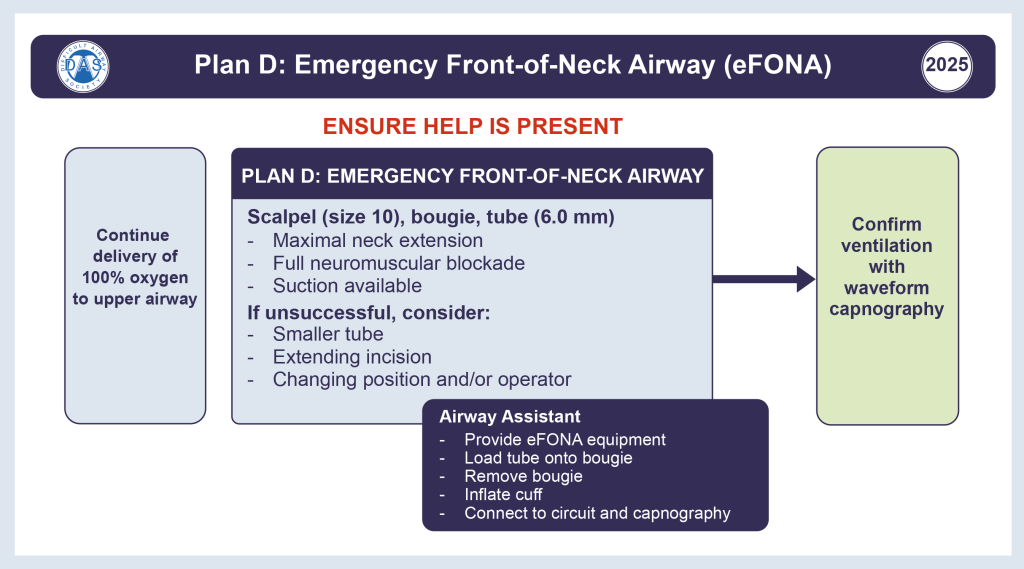
  • DAS 2025 uses a default vertical skin incision and a scalpel–bougie–tube approach, with a trained technique selected and communicated in advance.
  • Maintain oxygen delivery, ensure a full neuromuscular block and extend the neck maximally where feasible while the trained operator performs rescue.
  • Verify ventilation with sustained exhaled carbon dioxide, clinical response and continuous monitoring; secure the airway and arrange specialist aftercare.
Key red flags

No effective ventilation through the attempted routes, deteriorating oxygenation or an unreliable capnography trace demands explicit reassessment and progression through the rescue plan.

Continued fixation on laryngoscopy despite failure of oxygenation is a team emergency; state the problem clearly and direct attention to the agreed rescue route.

Reasoning priorities

01
Continuous waveform capnography

Assess ventilation throughout airway management and after rescue.

Check the monitor before induction and maintain its use through rescue. After a tube is placed, sustained exhaled carbon dioxide supports effective ventilation; absent or disappearing output requires immediate evaluation of patient, airway and equipment.

Worked reasoning

Worked caseProgress when every noninvasive route fails

During adult anaesthesia, intubation has failed and the prepared second-generation supraglottic device does not provide effective ventilation.

  1. The team makes the final face-mask attempt with two-person technique, appropriate adjuncts, optimised positioning and adequate anaesthesia and neuromuscular block. No effective chest movement or sustained capnography appears and oxygen saturation continues to fall.
  2. The airway lead declares cannot intubate, cannot oxygenate. The assistant opens the already located neck-access kit, a colleague continues oxygen delivery attempts and the trained operator proceeds to the agreed Plan D technique.
  3. The trained operator uses longitudinal skin access and blunt exposure to identify the cricothyroid membrane, opens the membrane and passes the cuffed tube over the bougie. After bougie removal and cuff inflation, ventilation produces repeated capnography waveforms and visible chest expansion; oxygen saturation then rises.
  4. The team secures the tube, continues monitoring and arranges surgical and critical-care assessment. The record includes the failed routes, timing, successful technique and observed response, making the outcome and future airway warning explicit.
Prepared adult rescueCoordinate operator, equipment and verification

Earlier rescue is becoming difficult and the team may need emergency front-of-neck access.

Open full textbook →Answer 2 questions
Sources and review status6 sources · checked 8 Sept 2026 · clinical review pending+
Sources

Sources and review status

National guidance is shown before implementation-dependent detail. Apply principles in context and verify current guidance when a decision affects care. Source check completed 8 Sept 2026; clinical approval remains outstanding.

  • DAS 2025 unanticipated difficult intubation: current adult algorithms
  • DAS 2025 official overview slides: rescue, monitoring and aftercare
  • DAS official change summary: default longitudinal approach and early preparation
  • DAS adult difficult-airway trolley: Plan D equipment
  • DAS April 2026 AirDrills facilitator guide: team transitions and debriefing
  • DAS 2025: official adult Plan D scalpel–bougie–tube figure

Editorial contact: Doctor’s Passport editorial team. Source-check date is separate from clinical approval. Report a content problem · Content changes

Authoring stateRapid draftClinical stateAwaiting reviewJurisdictionUnited Kingdom
  1. Communicate who will perform the procedure and who will assist, obtain further help and monitor physiology. Bring the actual kit into useable reach, with the current algorithm visible.
  2. The DAS adult trolley includes a size 10 scalpel, bougie, size 6.0 tracheal tube and cuff syringe for Plan D. Check that the team can locate and connect the equipment it is trained to use.
  3. Once Plans A–C cannot provide oxygenation, proceed to adult Plan D without another routine intubation cycle. Maintain upper-airway oxygen delivery, ensure full neuromuscular block and extend the neck maximally where feasible.
  4. The trained operator follows the current DAS sequence: longitudinal midline skin access with blunt exposure, identification and controlled opening of the cricothyroid membrane, then bougie placement into the trachea and advancement of a cuffed size 6.0 tube over it. Remove the bougie, inflate the cuff and connect the breathing system. These principles require hands-on procedural training and the current detailed algorithm.
  5. Assess the result immediately with capnography and clinical ventilation. If rescue is unsuccessful, verbalise failure and continue the current DAS Plan D troubleshooting with experienced assistance rather than declaring success from tube insertion alone.
After oxygenation is restoredSecure recovery and learn from the event

Emergency access has produced effective ventilation and the patient's oxygenation is improving.

  1. Secure the airway, continue physiological monitoring and obtain specialist review of bleeding, injury and the definitive airway strategy. Coordinate any transfer with a team equipped to manage another airway problem.
  2. Document the exact sequence and outcome and ensure that relevant clinical records carry the difficult-airway information. Explain the event to the patient when possible and support clear communication about future anaesthetics.
  3. Offer support to the people involved and conduct a structured team review. Identify a specific change such as correcting equipment placement or rehearsing the declaration that was delayed, then check that the change is implemented.