Principles and purpose
Calculate an initial adult burn-fluid plan within an explicitly selected protocol, preserve the injury clock and agreed prior-volume accounting, and titrate care from verified urine output, perfusion and evidence of fluid-related harm.
Major burns cause an inflammatory response with leakage of fluid from the circulation into tissues. Resuscitation aims to maintain effective perfusion while limiting harm from unnecessary volume. A formula estimates a starting requirement; it cannot directly measure capillary leakage, account for every associated injury or predict one patient’s renal and cardiac response. The prescription therefore links an initial calculation to repeated observation, delivered-volume checks and a responsible clinician able to change course.
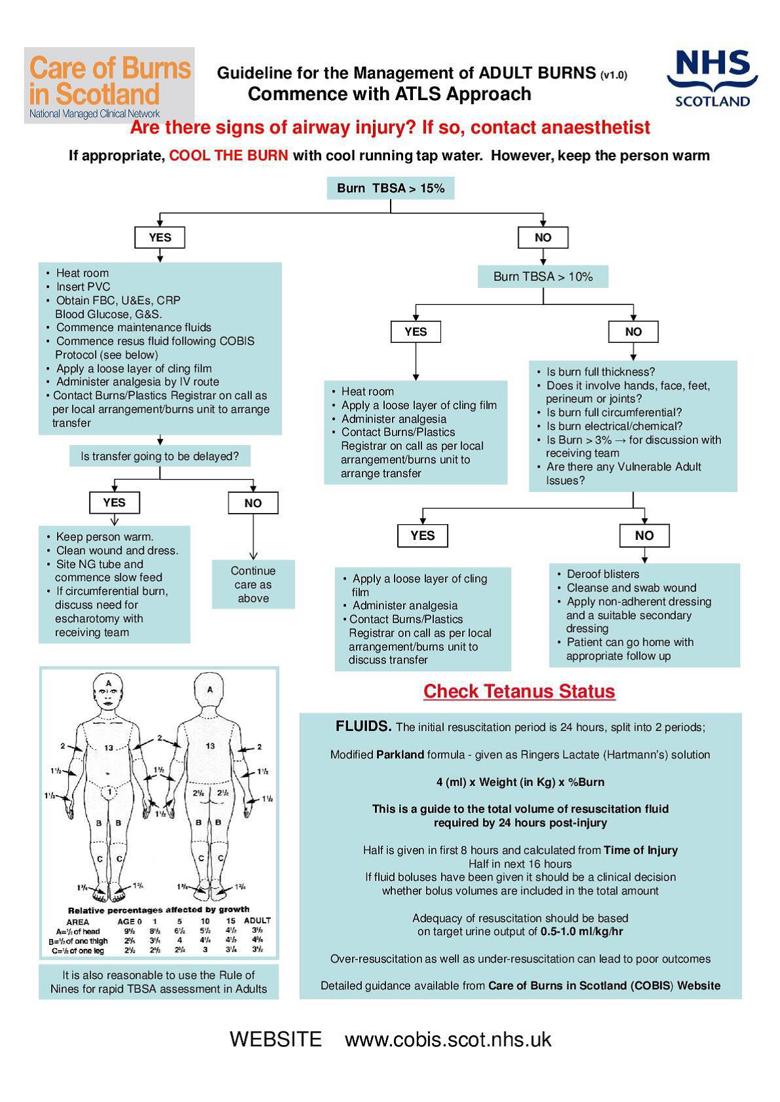
Different burn authorities use different initial coefficients and populations. The calculations here use the NHS Lothian page and its embedded COBIS adult chart together: actual weight for the fluid estimate, injury time for the eight-hour window and ideal weight for the stated urine-output target. Keeping those conventions explicit avoids combining parts of different protocols. The separate EMSB and ABA recommendations illustrate why a formula should be named, while current clinical findings and product suitability govern the actual infusion.