Synopsis
Calculate an initial adult burn-fluid plan within an explicitly selected protocol, preserve the injury clock and agreed prior-volume accounting, and titrate care from verified urine output, perfusion and evidence of fluid-related harm.
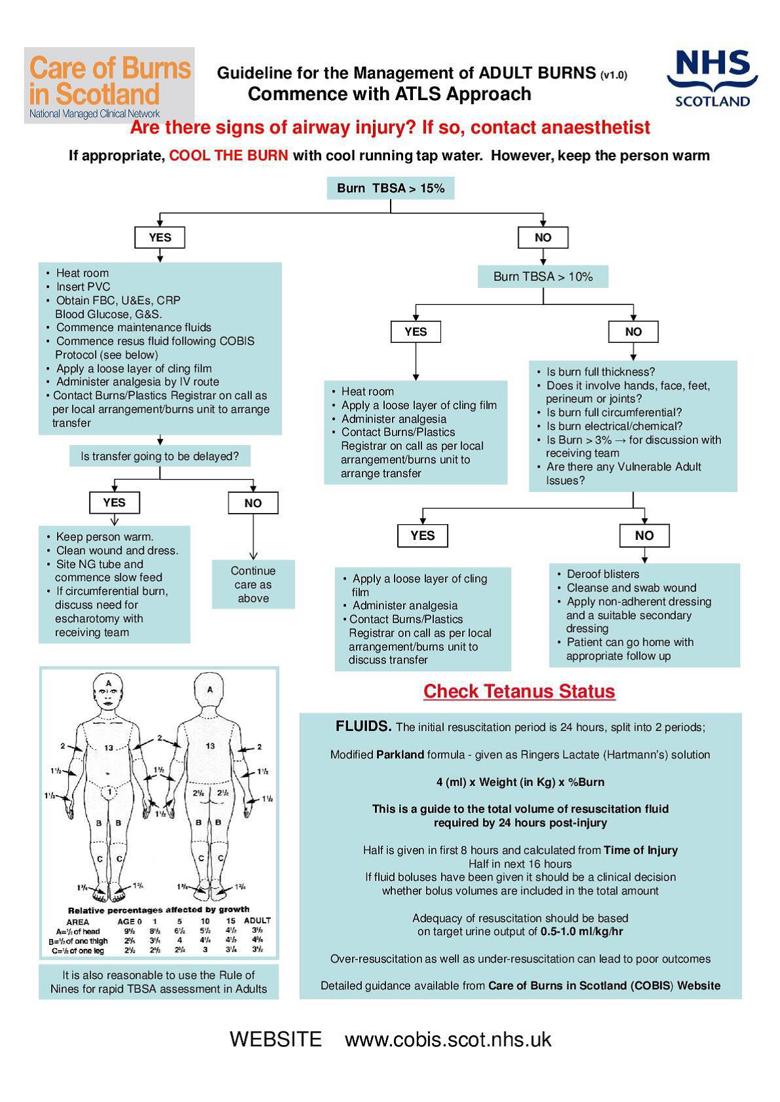
- The selected NHS Lothian/COBIS adult example uses burns greater than 15% TBSA and an initial 24-hour estimate of 4 mL × actual weight in kg × eligible %TBSA. This is a named local starting plan requiring clinical review.
- Give half of that estimate within eight hours from injury and the remainder over the following sixteen hours. Deduct only earlier resuscitation volume the burn team has explicitly credited, and divide by the time left in the initial window; arrival does not restart the clock.
- The selected local urine target is 0.5–1.0 mL/kg/hour using ideal weight. Verify drainage and assess perfusion, chemistry and overload before adjusting fluids; low output beyond two hours requires senior review, with immediate action for other deterioration.
- Keep maintenance, enteral intake, other infusions and any emergency boluses visible in the record. Whether a prior bolus counts toward the burn-formula estimate is a clinical decision, not an automatic subtraction rule.
- Use the chosen crystalloid only when its product-specific contraindications and compatibility have been checked. Severe renal or cardiac disease, abnormal electrolytes, lactate-handling problems and interacting treatment may require a different prescription.